When good ideas lead to confusing experiences
Banks know a lot about their customers. They know how often someone logs in, what products they use, how they tend to spend or save, and even what they might need next. This level of insight was not the problem at all. The problem is what happens next.
The customer may receive an email encouraging him to open a savings account. At the same time, they may see a message in their banking app about a credit product. If they contact support, the conversation may go in a different direction. Each interaction makes sense on its own. But together they feel separate.
From the customer’s perspective, the bank does not act as a single organization. It’s like a bunch of systems making independent decisions. This is the challenge that this article focuses on.
From Hackathon idea to real-world use case: Decision-Based Banking
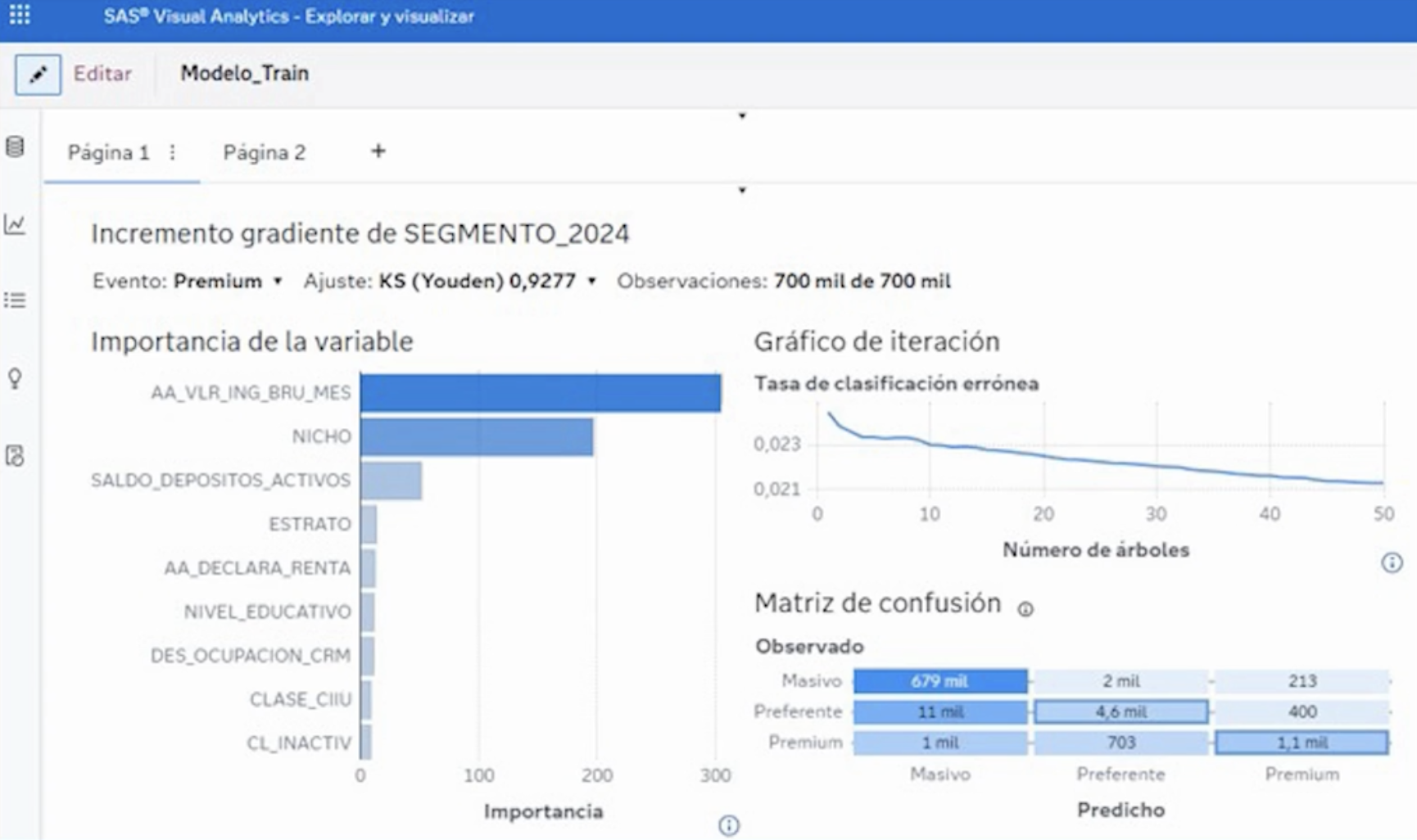
This use case was originally developed by Banco de Bogotá team As part of 2025 SAS Hackathon. Their goal was to explore how banks can move from fragmented customer engagement to a more coordinated, decision-led approach – where decisions are made once and implemented consistently across channels.
The approach itself is straightforward. The bank started with basic information, such as demographics and preferences, to build an initial understanding. Then you learn from customer behavior over time through transactions and interactions. As this picture became clearer, it continually improved how it grouped customers and used this understanding to guide what the bank should say or do next.
This type of approach is often referred to as “customer 360” or “customer segmentation.” It works well to understand customers. But it still leaves a key question unanswered: How does the bank turn this understanding into clear and consistent action?
Why is consistency so difficult?
In most banks, decisions are not made in one place. Marketing, digital, services, and product teams often manage their own channels, tools, and priorities. Even when they work from the same customer data, they don’t always behave the same way. This is why customers receive mixed messages.
It’s not a data problem. It’s a coordination problem. Most banks are not prepared to solve this problem centrally.
A different approach: Decide once, act everywhere
Instead of letting each system decide what to do independently, a better approach is to make one decision and use it everywhere. This decision answers a simple question: What is the single most relevant action for this customer right now, and how do we make sure every channel delivers the same message?
This is where SAS Intelligent Decision Making comes into play. It allows banks to bring together data, models and business rules in one place so decisions can be made consistently.
But there is still another challenge. Even when a bank knows the correct procedure, it must explain why that procedure was chosen, communicate it clearly to the customer, and ensure that the tone fits the situation.
This is where agentic AI comes in handy. It allows banks to support decision-making with AI in a controlled way, improving how decisions are communicated and understood without changing how they are made.
What the AI agent actually does in this context
An AI agent in banking is not a chatbot, and does not replace decisions. It acts as a coordinator within the decision-making process, helping to translate decisions into clear and consistent interactions with customers.
It helps with two important things:
- Transform decisions into clear communication
- Convert technical logic into understandable explanations
For example, a model might indicate that a customer is likely to take advantage of a savings product, while the business rules confirm that he or she is eligible and that the timing makes sense. The decision-making system chooses this action, and the AI agent helps translate it into a message the agent can understand.
At this point, the AI agent helps craft a clear and appropriate message, translates the technical logic into simple language, and ensures the communication aligns with the bank’s tone and policies.
The decision remains controlled and controlled. AI helps make this decision easier to understand and easier to implement.
That’s where SAS Agentic AI Accelerator fits in
Up until this point, the focus has been on making better decisions and keeping those decisions consistent. The next step is to make those decisions easier to communicate and understand. This is where SAS Agentic AI Accelerator fits in.
The accelerator provides a structured way to introduce AI into existing decision workflows without disrupting how decisions are made. Instead of treating AI as a separate experience, it becomes part of the system in a controllable and repeatable way.
In this example, the accelerator will be used to build an AI agent that sits alongside the decision-making process and helps with two main tasks.
First, it helps turn decisions into clear communication. Once a decision is made, the agent can create customer-facing messages that are consistent in tone, consistent with policy, and tailored to the situation.
Second, it helps transform technical logic into understandable explanations. It can take typical outputs and decision rules and translate them into simple language that can be used by customer support teams or even shared directly with customers when appropriate.
The important part is that the AI does not make the decision, it supports how that decision is implemented. With Agentic AI Accelerator, teams can build this capability once and reuse it across channels, rather than relying on separate teams or systems to interpret decisions in different ways.
Bring it all together
The Banco de Bogotá use case shows how banks can better understand their customers over time. The next step is to ensure that understanding leads to clear and consistent action.
By combining customer insight and segmentation, centralized decision making, and agentic AI for communication and interpretation, banks can move toward a model in which customers receive fewer but more relevant messages, interactions feel more intentional, and decisions are easier to apply consistently and explain clearly.
It’s not about adding more technology. It’s about making existing capabilities work together more effectively.
Customers don’t see systems, models, or channels. They experience conversations.
When these conversations are consistent, trust grows. When they are inconsistent, even strong ideas lose value. Agent AI, when used in the right way, helps bridge this gap, not by making decisions on its own, but by helping organizations act on their decisions more clearly and consistently.
This is where Agentic AI Accelerator becomes practical. It provides the architecture needed to build these agent-based capabilities in a way that is consistent, reusable, and compatible with how decisions are actually managed in SAS Viya.
Explore Agentic AI Accelerator
If this approach resonates, a good next step is to explore SAS Agentic AI Accelerator on GitHub. The repository provides a practical starting point for building agent-based workflows in SAS Viya, including examples, reusable components, and guidance on how to combine decision-making, AI, and orchestration in a structured way.
It’s designed to help teams move beyond ideas and experiments and start building real, controlled solutions that can scale. Whether you’re just starting to explore effective AI or are looking to expand existing decision-making workflows, it provides a clear path to start testing, learning, and applying these concepts in your own environment.
From Hackathon idea to real-world use case
If you’re interested in how this idea was developed, you can explore the team and their work on the SAS Hackathon platform: Banco de Bogota – SAS Hackers Hub.
The SAS Hackathon provides a space for teams like this to take on real business challenges, combine data, analytics and AI, and build practical solutions in a short period of time. Many of the concepts explored in this article, including centralized decision making and agentic AI, are being actively tested and improved through these hackathon projects.
This is a powerful example that innovation does not always start with large transformation programmes. Sometimes it starts with a focused use case, a small team, and the right tools to connect vision to action.