
Optical character recognition now powers receipt scanning, identity verification, invoice automation, historical archive digitization, and pen-based note applications. The OCR market is expected to reach $32.90 billion by 2030 at a CAGR of 14.8% (Grand View Research, 2024), with the fastest growth in intelligent OCR – the hand-reading and writing branch of OCR. Whether you’re creating document analysis, scene text detection, or handwriting transcription, the OCR dataset you train on sets your accuracy ceiling. This guide covers 22 free and open source OCR datasets – including the best handwriting datasets – organized by use case and updated with the most powerful versions through 2024.
Key takeaways
- OCR (Optical Character Recognition): A technology that converts images of printed, graphic, or handwritten text into machine-readable data.
- OCR datasets are divided into five groups: document/form, scene text, number/character, handwriting, and multilingual.
- Documentation of OCR datasets Capture organized pages such as forms and receipts; Scene text datasets Capture text “in the wild”.
- IAM, MNIST, ICDAR, and SROIE remain the most frequently cited OCR standards across papers.
- License terms vary widely — check each OCR dataset before commercial training.
What is Optical Character Recognition (OCR)?
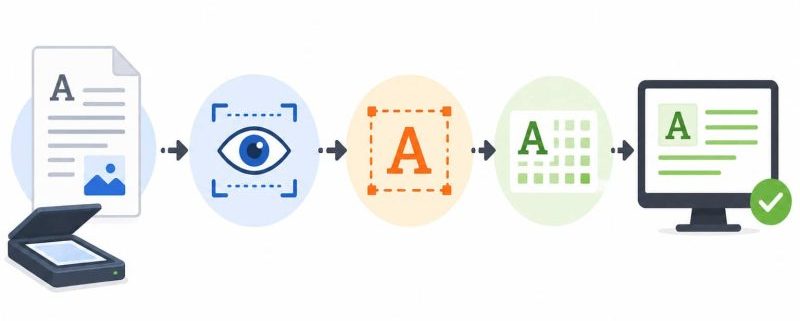
Optical character recognition (OCR) is a technology that converts various types of documents, such as scanned paper documents, PDF files, or images of text, into editable and searchable data. It works by:
- Analyze the structure of text in an image
- Divide text into lines and characters
- Converting these visible characters into machine-readable text
Common uses include:
- Convert scanned documents into editable text files
- Digitization of printed books
- Extract text from images
- Convert handwritten prescriptions into digital text
- License plate recognition
How to choose the right OCR dataset?
The selection of an OCR dataset depends on four factors: text type, capture environment, annotation details, and licensing. Optical character recognition (OCR) of a printed document needs different training data than handwritten or curved scene text. Document datasets fit invoices, forms, and receipts; Scene text datasets for signage and product reading; Handwriting datasets fit notes, manuscripts, and pen input. Word-level and line-level annotations support full OCR paths, while character-level sets fit basic lines of classification. Always confirm the license terms, as some OCR datasets are for research only or require registration.
What are the best document and form datasets for OCR?
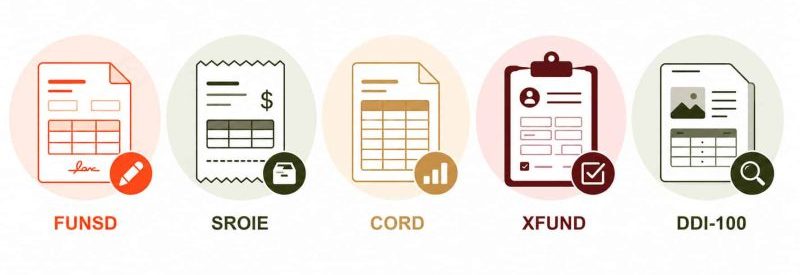
Optical character recognition (OCR) datasets train models to analyze structured pages such as invoices, forms, receipts, and IDs. These automate business documents and extract key value.
- fun – 199 scanned models annotated with a loud, realistic look. Standard benchmark for understanding the model and extracting the key value.
- Sarwa – ICDAR 2019 Scanned Receipts Dataset which includes nearly 1000 receipts, supports text detection, recognition and information extraction in one set.
- pregnancy — A unified receipt dataset designed for post-OCR analysis, with rich field-level labels to automate invoices and receipts.
- XFUND — Multilingual extension for FUNSD covering seven languages (German, Spanish, French, Italian, Japanese, Portuguese, Chinese) with 199 pages each. Ideal for multilingual documents AI.
- DDD-100 – About 100,000 distorted document images for detection and recognition under realistic degradation such as skew, blur and noise.
What are the best OCR datasets for scene text?
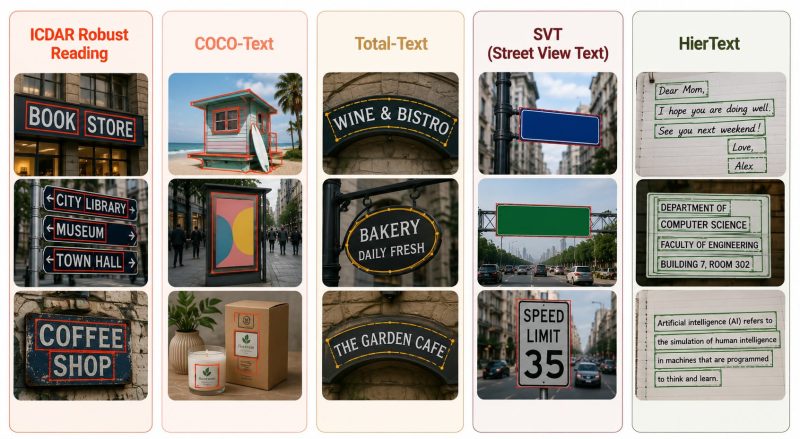
Scene text OCR datasets train models to read text in natural images such as signs, products, and street scenes. These elements are essential for optical character recognition (OCR) in wildlife where backgrounds are crowded.
- ICDAR powerful reading – The standard family behind most scene text research, including the challenges of focused and episodic scene text with bounding boxes and word-level transcription.
- Coco text – Extensive text annotations placed on MS-COCO images. Powerful for large-scale text detection in natural scenes.
- Total text -Specializes in curved and arbitrarily oriented text, a known weakness of older OCR models.
- SVT (Stream Street Text) – Word images collected from Google Street View, are often low resolution and high contrast. Available via Papers with Code Mirrors.
- HierText – Paragraph-to-line-to-word hierarchical annotation, covering handwritten and printed scene text. Useful for layout-aware OCR.
What are the best OCR datasets?
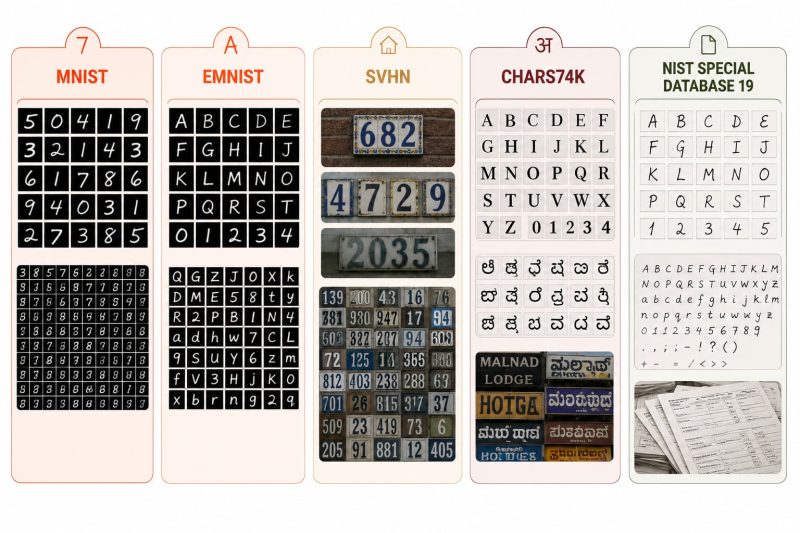
OCR datasets for numbers and letters train models to recognize individual symbols in controlled settings. These are the standard starting points for classification baselines.
- Mnist – 70,000 grayscale handwritten digital images. The fastest baseline for number classifier validation.
- Emnest – MNIST extends to 814,255 handwritten letters and numbers drawn from NIST’s proprietary database19.
- SVHN (Street View House Numbers) – Over 600,000 real digital images of house numbers. Practical step of MNIST for noisy conditions.
- Chars74K – 74,107 images covering English and Kannada letters from natural images and computer fonts.
- NIST Special Database 19 – Over 810,000 hand-printed portraits from 3,600 writers. The source from which many English OCR standards are derived.
What are the best handwriting datasets for OCR?
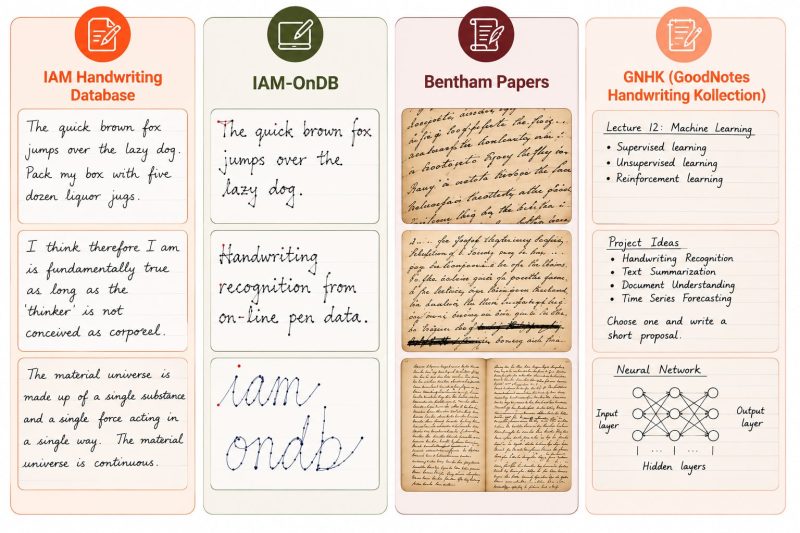
Handwriting datasets train OCR models to read handwritten, printed, and historical texts. The most powerful open handwriting datasets remain the most cited standards for handwritten text recognition (HTR).
- IAM handwriting database — The gold standard for English handwriting, containing 13,353 lines of text from 657 writers. It remains the most cited handwriting dataset in OCR research in 2024-2025.
- IAM-OnDB – The electronic version of IAM, which captures route data. Basic handwriting dataset for pen and tablet recognition.
- Bentham Papers – Historical English manuscripts written by the philosopher Jeremy Bentham. The leading standard for historical handwriting is Optical Character Recognition (OCR), which is accessible via Transkribus.
- GNHK (GoodNotes Handwriting Kit) – A 2021 dataset of real-world unrestricted English handwritten notes. Closer to messy production data than clean IAM in the lab.
What are the best multilingual and non-Latin OCR datasets?
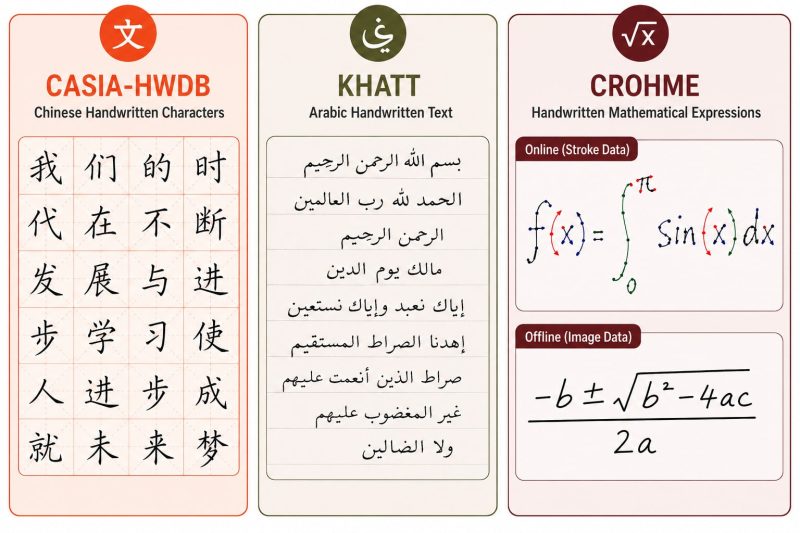
Multilingual OCR datasets train models on texts beyond English, including Chinese, Arabic, and mathematical symbols. These are necessary for global documents and handwriting recognition.
- Cassia-HWDB – Standard Chinese OCR, with 1.17 million samples of handwritten characters from 1,020 writers.
- Khut – 1000 handwritten examples in Arabic from 1000 distinguished writers, scanned at multiple resolutions. The most comprehensive open Arabic dataset for Optical Character Recognition (OCR).
- Chrome – Online handwritten mathematical expression recognition competition: over 10,000 expressions across more than 101 mathematical symbols, in both online and offline variants. Essential for OCR handwritten equation.
What are the common pitfalls when using free OCR datasets?
Three pitfalls that befall most teams.
Domain mismatch: Training on clean IAM or COCO-Text and publishing it on crumpled invoices guarantees twice the accuracy.
License Blindness: Many historical scene text and OCR datasets are intended for research only or require registration before commercial use.
Annotation gaps: Many OCR datasets lack layout metadata, line-level bounding boxes, or field labels that production systems need.
Imagine a mid-sized logistics company that automates the reading of shipping labels. Training on landscape texts gets them up to 80% on the benchmarks, but real posters with glare and folds take them down to 58%. Closing this gap requires targeting Explanation of data of 6,000 label images within the range before launch.
Benefits and challenges of open source datasets
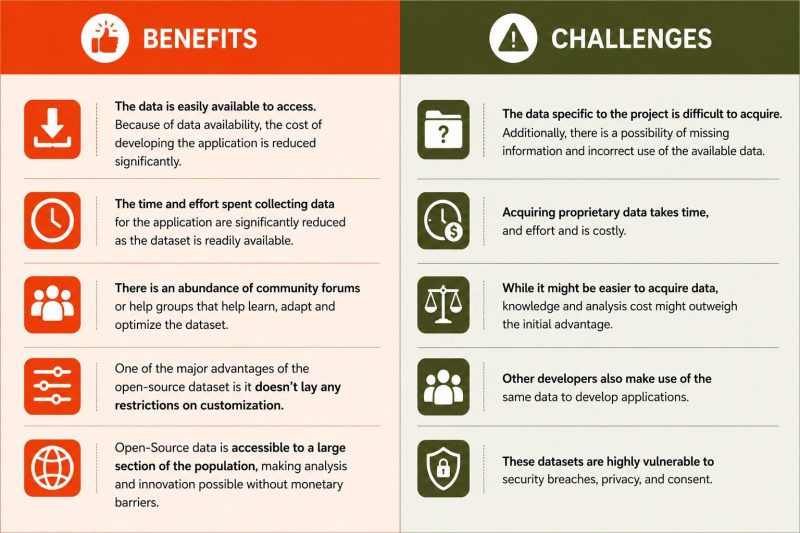
Companies need to pit the advantages and challenges against each other to understand whether they should choose free-to-use data for their machine learning applications.
benefits
- The data is easily available to access. Due to the availability of data, the application development cost is significantly reduced.
- The time and effort spent collecting data for the application is greatly reduced since the data set is readily available.
- There are an abundance of community forums or help groups that help in learning, adapting, and improving the dataset.
- One of the main advantages of the open source dataset is that it does not place any restrictions on customization.
- Open source data is available to a large segment of the population, making analysis and innovation possible without financial barriers.
Challenges
- Data for the project is difficult to obtain. In addition, there is a possibility of loss of information and incorrect use of available data.
- Obtaining ownership data takes time and effort and is expensive
- While the data may be easier to obtain, the cost of knowledge and analysis may outweigh the initial advantage.
- Other developers also use the same data to develop applications.
- These datasets are highly vulnerable to security, privacy, and consent violations.
How does Shaip support OCR and handwriting recognition projects?
He’s old Optical character recognition (OCR) training data services. Associate open dataset organization with custom Data collection Across more than 60 languages, including printed documents, handwriting, receipts, and IDs. Shaip annotation workflows add the common layers that OCR datasets miss: line-level bounding boxes, field-level labels, copy quality control, and writer metadata.
conclusion
The 22 OCR datasets above give you a complete open source foundation across document, scene text, number, handwriting, and multilingual recognition for 2026. Start with an OCR dataset that matches your text type and capture environment, validate it against a saved sample of your real data, and an allocated annotation budget to fill the industry gap. This combination ships faster than building from scratch.