An accurate, well-designed machine learning model will almost always perform worse when dealing with poor-quality data (e.g., noisy or corrupted) than a simple model trained on high-quality data.
The difference will grow exponentially with the size of the data. A fraud detection system that is trained on a weak sample of transactions (for example, only on deviations from historical spending behavior rather than other types, such as tracking account activity or geolocation anomalous transactions) will result in more false alarms.
Hence, the training data must be accurate for any machine learning model to be successful, which brings us to our main topic, i.e. “What are the reliable sources for obtaining AI training data for machine learning projects?”
Before finding sources of AI training data for machine learning projects, our readers should understand what makes good data.
What makes an AI training data source “reliable”?
Finding the right data sources to train your model is often the hardest part, which is why it is very important to consider the following criteria.
What is its importance?
A machine learning model that is trained on a specific set of data, called “training data,” faces the risk that after deployment, the data it receives may perform poorly because it sees unfamiliar patterns. This is sometimes called a “distribution shift.” Another way to understand this is to train an image classification model on daylight images, but after publishing, it receives night images. The runtime input distribution (night images) is different from the training distribution (day images), which can confuse the model.
Is it compatible?
In commercial environments, licensing and compliance are non-negotiable. There is no safe harbor for companies that inadvertently or otherwise engage in data sharing practices where the intellectual property is ambiguous, and the data is collected in violation of the General Data Protection Regulation (GDPR), CCPA, HIPAA, and other compliance regulations. Form accuracy is no excuse for non-compliance.
Is it quality?
Data quality is how accurate and reliable the data is. In general, high-quality data is accurate, complete, consistent, reliable, and free of noise, classification errors, or missing information. It must not contain any noise, typographical errors, or other errors. A dataset containing millions of poorly classified samples can degrade model performance, while a smaller dataset with finer classifications often yields more reliable results.
Is your data up to date?
When dealing with data, it’s really important to consider how recent this data is, whether it’s up to date or not. For example, if you’re using a word list from 2018, it probably wouldn’t be very useful today because language, slang, and pronunciations are always evolving. Using outdated data can lead to errors and poor model output.
All of the above factors should be taken into consideration when selecting data sources, as the right choice varies depending on data availability, quality, and compliance requirements across organizations and industries.
It is worth noting that understanding what makes data reliable is only half the equation; Let’s explore where these high-quality data sources can actually be found.
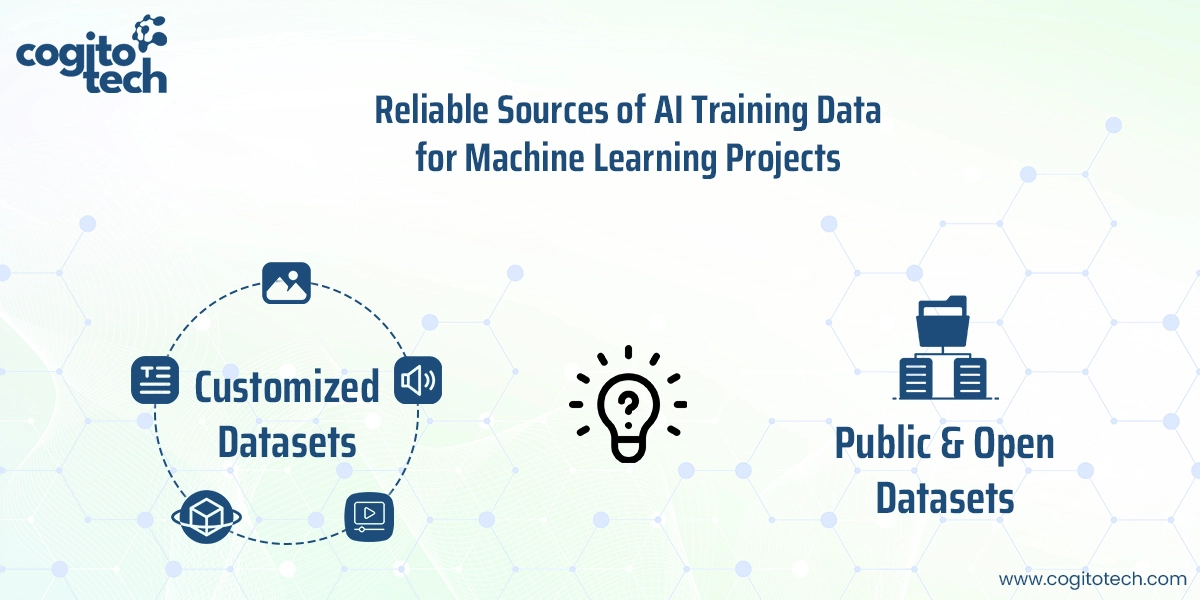
Public and open datasets: the starting point for AI development
Open data refers to publicly released datasets by governments, research institutions, companies, and open source communities. Ideally, this data is structured, machine-readable, open-licensed, and well-maintained. Most modern AI research relies on a large number of publicly available datasets obtained from universities, government agencies, and open source research communities. Some of them:
- The datasets are distributed through platforms such as Hugging Face, and are aggregated contributions from research groups and open source communities.
- The datasets are sourced from UCI’s Machine Learning Repository, which hosts a curated collection of datasets contributed by the machine learning community for benchmarking and research.
- Datasets can be discovered through Google Dataset Search, a search engine that indexes dataset metadata across the web, providing access to datasets hosted by universities, government agencies, and research institutions.
Open data comes from governments around the world and is usually public. For example, data.gov (USA), the EU Open Data Portal, and datasets such as Common Crawl, Wikipedia dumps, and Pile are used to pre-train language models.
These datasets have several shortcomings, especially in an enterprise environment. First, the datasets contain gaps in some industry sectors, languages, and regional areas. Second, the quality and style of annotations varies widely. What’s even more annoying is that many labeling schemes are not useful for production. Finally, the terms of most licenses that accompany the data are appropriate for research but not for commercial use.
Public open data works well in the initial stages of an AI project, but is not effective in complex real-world industries. This is where we come in. Cogito Tech delivers high-quality private training data for enterprise-level applications.
Custom datasets from Cogito Tech
While open datasets can help you get started, building something truly industry-specific means you need more than what’s freely available – you need a data partner. Whether it’s an urgent, short-term data requirement for a shipping pilot or a long-term collaboration aligned to your project, the right partner makes a big difference.
At Cogito Tech, we cover it all, and the formats we offer are broken down in the section below
Look at training data by format
AI models learn by training on different types of data: text, images, audio, video, and more. Each format shapes what the form can do. Here’s a quick overview of the main data formats that go into training a machine learning model.
A. Text: The basis of linguistic intelligence
Textual data comes from various sources such as web pages, books, research articles, source code, chat conversations, and social media posts. Together they represent one of the richest sources of human knowledge available. It is used to train linguistic models to learn grammar, thought patterns, real-world associations, and even dialect from this type of data.
for. Pictures: Teaching machines to see
Visual data gives AI systems the ability to interpret the world the way humans do. It is useful for machines to absorb information from photographs, illustrations, medical scans, satellite images and screenshots. Since all of these visuals contain different types of visual information, we add metadata that describes everything from the device used to the location where they were taken, providing a complete digital fingerprint of the images.
C. Audio: Capture the nuances of sound
Developing speech recognition systems requires large amounts of audio data that includes samples of different speech styles, such as accents, speaking speeds, and different background noises. This audio data is also crucial in learning and training music and other sounds to generate and classify sound. Environmental sounds are very useful for fine-grained classification, such as distinguishing between a siren and a doorbell, and for complex industrial use cases, such as detecting anomalies in the sounds of heavy machinery.
D. Video: Understanding motion and context over time
Video is one of the most information-dense training formats, capturing movement, temporal relationships, and contextual changes over time. Unlike a still image, a video carries movement, sequence, cause-and-effect relationships, and temporal context. Raw footage, annotated clips, and screen recordings serve different training purposes, from teaching models to familiarizing themselves with procedures and events, to enabling them to understand workflows and user interfaces.
e. 3D and spatial data: Building artificial intelligence that understands physical space
As AI moves into robotics, self-driving vehicles, and augmented reality, 2D data is simply not enough. Point clouds, computer-aided design (CAD) models, and LiDAR scans give AI systems a 3D understanding of physical environments, how things relate to each other in space, where surfaces begin and end, and how the scene changes as a vehicle or robot moves through it.
conclusion
Great AI starts with great data. This is what we do at Cogito Tech – A trusted source of AI training data, with a team of expert annotators who prepare the data for different industrial applications. Our services include data centers specializing in areas such as vision-based modeling, NLPMedical imaging and geospatial data. We’ve created a professionally annotated dataset of human-verified labels, tailored to our customers’ needs.
(tags for translation) Data Explanation