
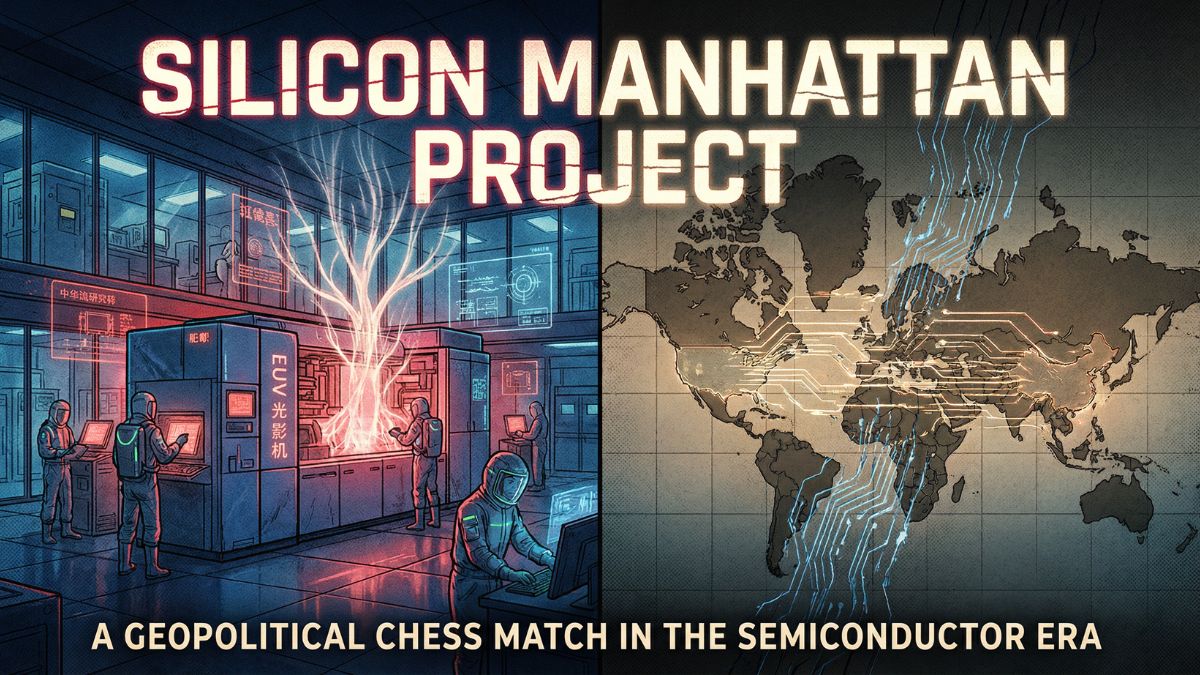
Reports emerged this week confirming what many industry observers have long suspected but been afraid to explain: China has launched a semiconductor “Manhattan Project.” This massive state-backed initiative has a unique existential goal: to reverse-engineer the ultra-complex lithography machines currently monopolized by the Dutch company ASML. By decoding extreme ultraviolet technology, Beijing aims to break down the floodgates of US sanctions and achieve self-sufficiency in manufacturing the chips needed to train frontier AI models.
This is not just industrial espionage on a large scale; It is a geopolitical inflection point. The race for AI dominance is the defining conflict of the 21st century, and the starting gun has just fired for the second time. according to Exclusive reporting from Reuters and Taiwan NewsChina has already built an operational prototype in a high-security Shenzhen laboratory that successfully generates UV light. The consequences for American leadership are profound, the scale of China’s commitment is staggering, and the opportunity for the West to maintain its advantage is narrowing more quickly than policymakers realize.
The threat to American hegemony
Over the past few years, the United States’ strategy for dealing with China’s technological rise has relied on armed interdependence. By controlling key choke points in the semiconductor supply chain – specifically, ASML’s advanced chip design software and irreplaceable manufacturing tools – Washington has effectively strangled China’s ability to develop advanced artificial intelligence. ASML’s UV machines are marvels of engineering, using lasers to vaporize molten tin to create light wavelengths capable of printing transistors just nanometers wide. They are the only tools capable of making the chips that power today’s most advanced generative AI models.
If China’s “Manhattan Project” succeeds in replicating or surpassing this technology, the basic lever of American technological power will be broken. American leadership in the field of semiconductors is currently defined not only by innovation such as Nvidia’s, but also by the ability to deny adversaries access to that innovation. A self-sufficient China, armed with domestic lithography capable of sub-7nm production, would immediately abolish current export controls. This would unleash a flood of Chinese-developed AI capabilities with direct military and economic applications, effectively ending the unipolar moment in technology dominance. As noted by Asia TimesThe effort is designed to take the United States out of the supply chain entirely.
A tale of two measures: Asymmetric efforts
Comparing Western efforts to revitalize chip manufacturing with China’s new initiative reveals a startling asymmetry. The United States celebrated the passing of Chips Law and Sciencea $52 billion package designed to attract manufacturing to American soil. Although important in the Western legislative context, it is a market-based incentive program constrained by political infighting and corporate bureaucracy.
Conversely, China’s approach appears to go far beyond anything the West is currently doing. This is not a support program. It is a national mobilization based on war. The project is said to be supervised by him Deng Xuexiang, a close ally of President Xi JinpingAnd coordinated by Huawei. Beijing deploys state capitalism with unlimited liability, hiring former ASML engineers with huge bonuses and, in some cases, providing them with jobs. Fake identities to avoid detection.
While the United States relies on private companies like Intel or Micron to make business decisions consistent with national security, China directs state resources to solve a physical problem regardless of the immediate return on investment. The Chinese government realizes that it is not about market share; It is about sovereignty. The amount of resources Beijing can delegate to confront a single technological hurdle outweighs the patchwork of incentives currently offered by the United States and its European allies.
The ticking clock on Western Drive
How long does the United States and its allies have before China overtakes them? It is tempting to dismiss this effort by pointing out the enormous complexity of ASML machines, which took decades of global collaboration to perfect. ASML’s CEO said earlier this year that China will need “Many, many years” To replicate this technology.
However, underestimating China’s technological speed is a historical mistake. While the prototype is currently struggling with visual fidelity and has not yet produced working slides, the timeline is tight. Sources close to the project cite a goal of producing working chips by 2028, with a “realistic” target of 2030. This is likely years ahead of Western expectations. If China spends hundreds of billions of dollars and its best scientific minds on solving this problem, the advantage that the West has enjoyed for a decade may shrink to three to five years. Moreover, China may not need to perfectly imitate ASML machines; It just needs a “good enough” alternative that allows it to train competitive AI models, even at a higher cost or lower return. The danger zone for the West is not in 2035; Starting before 2030.
American determinism: beyond defense
To prevent overreach, the United States must accept that defensive measures — sanctions and export controls — serve to delay action, not a strategy for victory. The current leaks in the sanctions regime indicate China’s ability to do so Source components from secondary marketsshowed that determined actors find alternative solutions.
The United States needs an offensive strategy that matches the urgency of China’s mobilization. First, it requires a radical increase in federal funding for research and development of next-generation semiconductor technologies, moving beyond silicon to areas such as advanced packaging and new materials in which the United States continues to lead. Second, the alliance with the Netherlands and Japan must be tightened, to ensure that the technology denial system does not collapse under Chinese economic pressure. Finally, the United States must win the talent war, reforming immigration policies to ensure that the world’s brightest engineers choose Silicon Valley rather than Shenzhen.
wrap
China’s semiconductor “Manhattan Project” is a clear signal that Beijing views technological dependence on the West as an intolerable weakness, and that it is willing to spend any amount to bridge the gap. The United States cannot win this race simply by trying to obstruct the other runner. They must act faster, invest deeper, and realize that the comfortable lead they enjoyed in the Silicon Age is over. The age of AI will be contested by the inch by the nanometer, and as these reports confirm, the race is much closer than we thought.

As President and Principal Analyst of The Enderle Group, Rob provides regional and global companies with guidance on how to create a trusted dialogue with the marketplace, target customer needs, create new business opportunities, anticipate technological changes, select vendors and products, and practice zero-dollar marketing. Rob has worked for over 20 years at and with companies such as Microsoft, HP, IBM, Dell, Toshiba, Gateway, Sony, USAA, Texas Instruments, AMD, Intel, Credit Suisse First Boston, ROLM, and Siemens.
(tags for translation) Artificial Intelligence superiority