Modern organizations rely on thousands of monitoring tools to ensure that applications, infrastructure, networks, cloud services, and security systems remain intact. Each component creates alerts aimed at notifying teams of potential issues before they turn into business disruptions.
However, more alerts do not necessarily translate into better visibility.
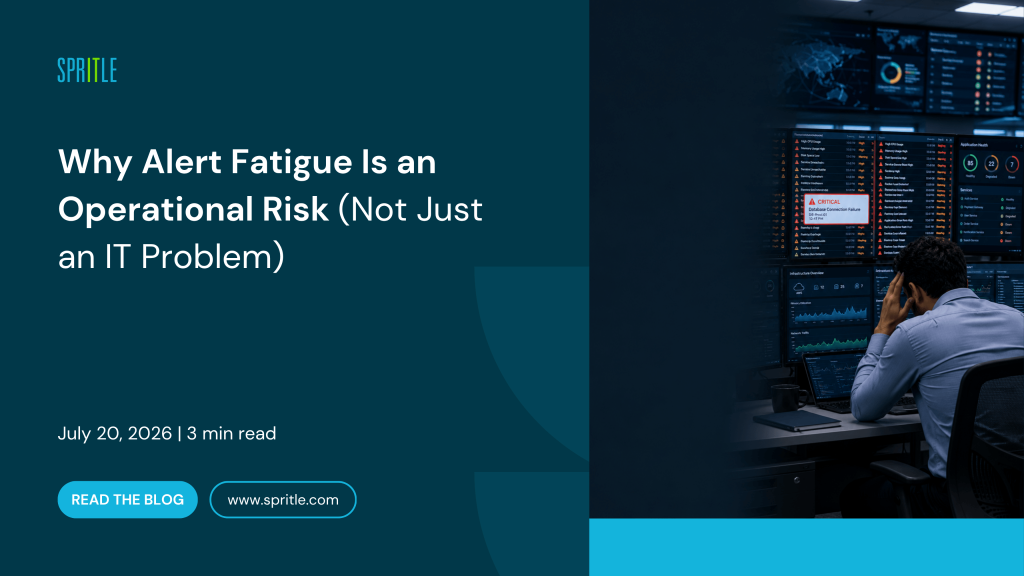
Many IT operations teams now receive hundreds or even thousands of notifications daily. When every event is flagged as critical, identifying alerts that truly require immediate action becomes increasingly difficult. This phenomenon is known as Fatigue alertand has evolved from an operational inconvenience into a major commercial risk.
Organizations that fail to address alert fatigue often experience slower incident response, prolonged power outages, increased operating costs, and decreased customer satisfaction.
This article explores why alert fatigue occurs, its impact on business, and best practices organizations can adopt to reduce alert noise while improving operational resilience.
Alert fatigue occurs when IT teams receive so many notifications that they begin to ignore, delay, or miss important alerts.
Over time, engineers become insensitive because many alerts are repetitive, low priority, or false positives. Instead of improving system reliability, excessive alerting overwhelms operations teams and reduces their ability to respond effectively during real incidents.
Alert fatigue typically affects:
- IT operations teams
- Site Reliability Engineers (SREs)
- DevOps Engineers
- Network Operations Centers (NOCs)
- Security Operations Centers (SOCs)
- Cloud operations teams
Enterprise technology environments are much more complex than they were just a few years ago.
The organizations now manage:
- Hybrid cloud environments
- Multi-cloud infrastructure
- Containerized applications
- Kubernetes clusters
- Microservices architectures
- Application programming interfaces
- Remote workforce infrastructure
- SaaS applications
- Edge devices
Each system produces telemetry, logs, metrics, events, and notifications independently.
Without intelligent correlation, a single infrastructure issue can generate hundreds of duplicate alerts across multiple monitoring platforms.
Instead of receiving a single actionable incident, operations teams receive a deluge of notifications describing the same underlying issue.
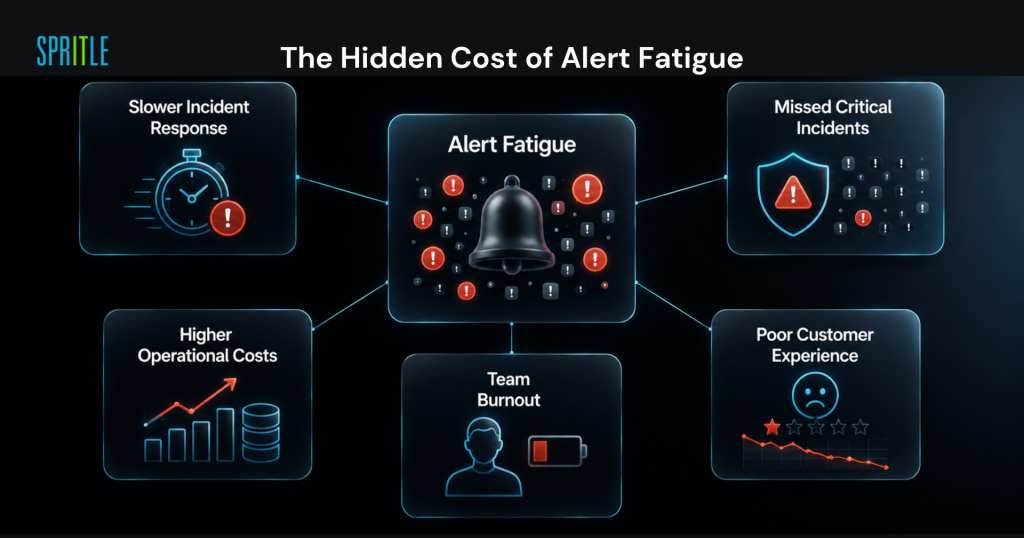
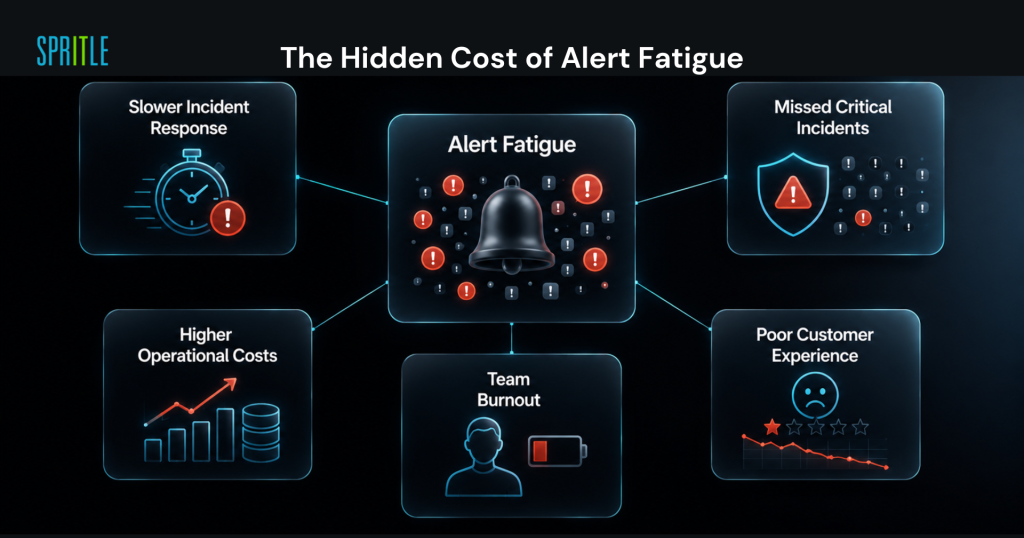
Alert fatigue affects much more than the IT department. Its consequences extend to business operations, customer experience, and organizational performance.
Slower response to incidents
Important alerts can become buried under hundreds of low-priority notifications.
Engineers spend valuable time identifying alerts that require immediate attention rather than solving the actual problem.
This increases the mean time to detection (MTTD) and mean time to resolution (MTTR).
Increased risk of loss in serious accidents
When teams become accustomed to frequent false alarms, they naturally begin to mentally filter out the notifications.
Unfortunately, important alerts can be ignored along with routine notifications, delaying responses to major incidents.
High operational costs
Responding to unnecessary alerts consumes engineering time that could otherwise be spent on:
- Improving infrastructure
- Automation initiatives
- Performance improvements
- Strategic technology projects
Organizations effectively pay skilled engineers to investigate events that may not require action.
Team fatigue
Constant interruptions increase cognitive load.
Engineers who frequently work on call rotations experience increased stress, decreased focus, and decreased job satisfaction.
Over time, alert fatigue contributes to employee burnout and retention challenges.
Customer experience suffers
Delayed incident resolution directly affects customers.
Service outages, application slowdowns, and performance degradation reduce customer confidence while increasing support tickets and losing potential revenue.
Many operational challenges contribute to over-alert.
Configure weak alert
Many monitoring systems are configured with default thresholds that generate alerts for every minor fluctuation rather than for meaningful operational risks.
Duplicate monitoring tools
Organizations often use multiple monitoring solutions simultaneously.
Infrastructure Monitoring, Application Monitoring, Cloud Monitoring, and Security Monitoring may all report the same issue independently.
Without consolidation, a single outage can trigger dozens of nearly identical alerts.
Not prioritizing alerts
Not every alert deserves immediate action.
When information notifications appear alongside critical production failures, engineers have difficulty identifying the most important incidents.
Fixed thresholds
Traditional monitoring relies on predefined thresholds.
Modern workloads fluctuate constantly, making fixed limits unreliable.
This results in frequent false positives during expected workload variations.
Limited context
Alerts that simply state that “CPU usage exceeds 85 percent” provide little operational value.
Without contextual information, engineers must manually check logs, dependencies, infrastructure health, and recent deployments before identifying the root cause.
Your organization may already be affected if you notice any of the following:
- Engineers routinely ignore alerts.
- Alarm acknowledgments are delayed.
- Several engineers are investigating the same incident independently.
- False positives greatly outnumber real incidents.
- Serious incidents are detected through customer complaints rather than monitoring.
- On-call engineers report excessive amounts of notifications.
- Incident response times continue to increase despite additional monitoring tools.
Reducing alert fatigue requires improving the quality of alerts rather than simply reducing their quantity.
1. Remove duplicate alerts
Link related events into one actionable incident.
Instead of receiving dozens of notifications, teams should receive a single incident rich with relevant diagnostic information.
2. Prioritize alerts based on business impact
Classification of alerts according to operational severity.
For example:
| priority | example |
| Very important | Production interruptions affect customers |
| High | Basic application performance deteriorates |
| Mediation | The capacity is approaching the threshold |
| a little | Information system events |
This helps engineers focus on incidents that directly affect business operations.
3. Adjust alarm thresholds regularly
Monitoring configurations must evolve alongside the infrastructure.
Review historical alert patterns to eliminate annoying alerts and optimize thresholds based on actual operational behavior.
4. Use the Smart Alert link
Modern monitoring platforms can automatically link to:
- Infrastructure metrics
- Application performance
- records
- Network events
- Dependency relationships
This provides a clearer picture of the underlying issue while reducing recurring notifications.
5. Automate routine responses
Not every alert requires human intervention.
Automated workflows can solve common operational problems such as:
- Restart failed services
- Clear cache
- Scaling cloud resources
- Periodic records
- Restart containers
Automation allows engineers to focus on complex incidents that require human expertise.
6. Continuously measure alert quality
Instead of just measuring alert volume, monitor metrics like:
- Alert to incident ratio
- False positive rate
- Average time to detection
- It means time to solve it
- Time to acknowledge the alert
- Percentage of actionable alerts
These indicators provide better insight into the effectiveness of monitoring.
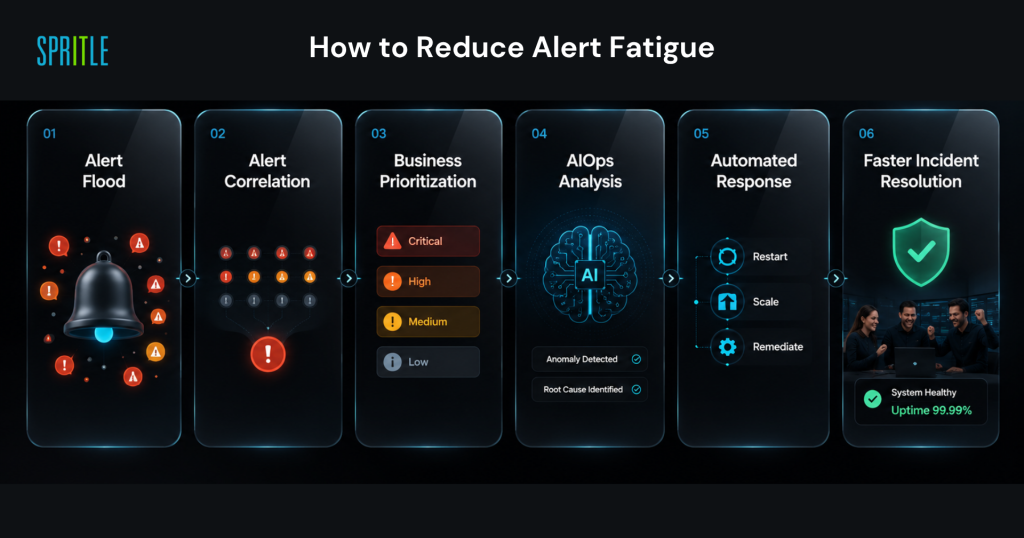
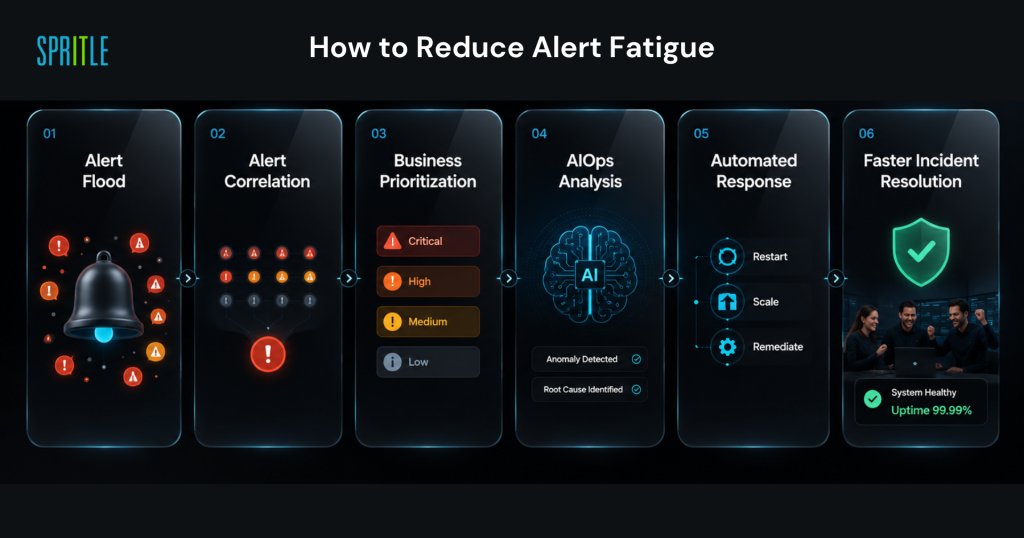
Artificial Intelligence for IT Operations (AIOps) helps organizations manage increasing monitoring complexity by analyzing large amounts of operational data in real-time.
Instead of simply forwarding every event, AIOps platforms can:
- Automatically detect anomalies
- Suppress duplicate alerts
- Link related events
- Predict potential failure
- Identify potential root causes
- Recommending treatment procedures
By reducing manual analysis, AIOps enables operations teams to respond faster while reducing unnecessary interruptions.
Effective monitoring isn’t just about generating more alerts. It’s about getting the right alert to the right team at the right time.
Organizations should periodically review their alerting strategy to ensure monitoring systems align with business priorities rather than just collecting technical events.
A mature alarm management approach combines intelligent monitoring, event correlation, automation and continuous improvement to improve operational efficiency and service reliability.
Alert fatigue is no longer just an operational challenge for IT teams. It is a business risk that impacts productivity, customer experience, employee well-being and organizational resilience.
As enterprise environments continue to grow in complexity, organizations must move beyond traditional monitoring methods that overwhelm teams with excessive notifications.
By implementing intelligent alert management, optimizing monitoring strategies, automating repetitive tasks, and leveraging modern monitoring and AIOps capabilities, companies can reduce operational noise while ensuring critical incidents get the attention they deserve.
The goal is not fewer alerts for the sake of simplicity, but better alerts that enable faster decisions, faster solutions, and more reliable digital operations.
Frequently asked questions
What is alert fatigue in IT operations?
Alert fatigue is a condition in which IT teams become overwhelmed with excessive monitoring notifications, resulting in responses to important alerts being ignored or delayed.
Why is alert fatigue an operational hazard?
Alert fatigue can lead to missed incidents, slower response times, increased downtime, higher operating costs, employee fatigue, and poor customer experiences.
What causes alert fatigue?
Common causes include duplicate alerts, poorly configured thresholds, multiple monitoring tools, false positives, static alert rules, and insufficient contextual information.
How can organizations reduce alert fatigue?
Organizations can reduce alert fatigue by setting alert thresholds, removing duplicate notifications, prioritizing alerts based on business impact, implementing intelligent alert correlation, automating routine processing, and continuously measuring alert quality.
How does AIOps help reduce alert fatigue?
AIOps analyzes operational data to detect anomalies, correlate relevant events, suppress duplicate alerts, identify root causes, and recommend remediation actions, enabling faster and more efficient incident response.