Unimodal vs. Multimodal at a glance:
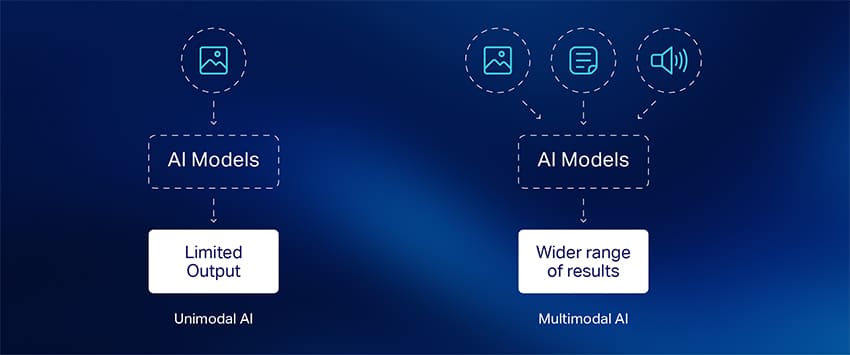
The journey from single-mode to multimodal AI represents a significant technological advancement. Early AI systems were highly specialized—image classifiers could identify objects but couldn’t understand associated text descriptions, while natural language processors could analyze sentiment but missed visual cues that provided crucial context.
How Multimodal AI Models Actually Learn
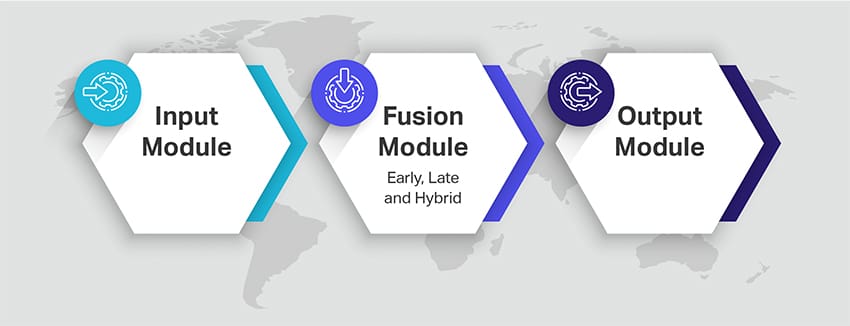
Every multimodal model runs on the same three-stage pipeline: encode, fuse, decode. What happens at each stage determines what kind of training data you need.
Stage 1: Encoders — Converting Raw Data Into Vectors
Each modality enters through a specialized encoder that converts raw input into a numerical embedding. A vision encoder (typically a convolutional network or Vision Transformer) converts an image into a feature vector. A text encoder, usually transformer-based, does the same for text. An audio encoder processes frequency patterns from speech or sound.
These encoders can be trained from scratch, or initialized from pre-trained models like OpenAI’s CLIP, which learns a shared embedding space for images and text by training on 400 million image-caption pairs. The quality of your training data at this stage determines how well each encoder generalizes to your domain.
Stage 2: Fusion — Where the Model Builds Cross-Modal Understanding
Fusion is where multimodal learning actually happens. The model has to reconcile embeddings from different modalities into a single representation. There are four main strategies:
- Early fusion: Raw inputs are combined before encoding. Simple, but sensitive to noise in any one modality.
- Late fusion: Each modality is encoded separately and combined at the decision layer. More robust, but potentially misses fine-grained cross-modal relationships.
- Hybrid fusion: A mix of both, processing some modalities jointly and others independently.
- Dynamic (adaptive) fusion: The model learns to weight each modality based on input quality at inference time. If audio is noisy, the model down-weights it automatically. This approach, covered in recent work from Encord’s ICLR 2026 analysis, is now considered best practice for production deployments.
(CALLOUT: Cross-modal attention is the mechanism that makes fusion precise. Originally demonstrated in the ViLBERT architecture (Lu et al., 2019), and refined in CLIP and ALIGN, it works by computing attention scores between tokens from different modalities — for example, aligning the word “crack” in a maintenance report with the specific region of an X-ray image where a fracture appears. Training data quality directly determines how accurately these attention relationships form.)
Stage 3: Decoder — Producing Outputs
The decoder generates the model’s output: a text answer, a bounding box, a classification label, or a generated image. For the decoder to be reliable, the fusion layer must have seen enough correctly aligned examples during training to learn stable cross-modal associations.
This has a direct implication for your dataset: misaligned pairs — an audio clip paired with the wrong transcript, or an image captioned with a description of a different scene — corrupt the fusion layer’s learning. One mislabeled example in a paired dataset causes more damage than one mislabeled example in a unimodal one, because it misleads two modalities simultaneously.
Shaip’s data annotation and labeling process includes cross-modal consistency checks at every stage for exactly this reason.
Multimodal Training Data by Industry Vertical
Different industries need different modality combinations. Here are five verticals where multimodal AI has moved from pilot to production — with verified public deployments.
1. Healthcare: Combining Imaging, Clinical Notes, and Speech

Google DeepMind’s Med-Gemini (2024) demonstrated what happens when multimodal training data is done right at scale. Published in Nature in 2024 by Saab et al., the research showed that a multimodal model trained on medical images, clinical notes, and patient history significantly outperformed unimodal baselines across 14 medical benchmarks — including radiology report generation and pathology image analysis.
The training data requirements are strict: imaging data must be DICOM-compliant, patient records must be de-identified to HIPAA standards, and speech data from physician dictation must be transcribed with medical vocabulary accuracy. Shaip’s healthcare training data catalog provides de-identified, HIPAA-compliant datasets across CT, X-ray, MRI, physician dictation, and EHR data — built specifically for teams training clinical AI models.
2. Autonomous Vehicles and Robotics: Sensor Fusion at Scale
Tesla’s Full Self-Driving system uses data from eight cameras, ultrasonic sensors, and a forward-facing radar — processing all streams simultaneously to make real-time driving decisions. The training dataset is built from millions of on-road miles with frame-level annotation across every sensor stream.
Waymo and Boston Dynamics (partnering with Google DeepMind on Gemini Robotics, announced at CES 2026) rely on LiDAR + camera + IMU fusion. As Jensen Huang noted at CES 2026, physical AI — robots that combine vision, language, and sensor understanding — represents the next major multimodal frontier.
The common thread: these systems fail when sensor modalities are not synchronized to sub-millisecond precision in the training data. Temporal misalignment between camera frames and LiDAR sweeps creates ghost artifacts that the model learns as real features.
3. Retail and E-Commerce: Visual Search Meets Natural Language

Amazon’s visual search product, StyleSnap, combines image embeddings with text query processing to match a customer’s uploaded photo against catalog items. The training data requires paired image-text examples where the visual and textual descriptions are semantically equivalent — not just keyword-matched.
When product images are annotated with structured attributes (color, material, silhouette, style era) and paired with actual customer search queries, conversion accuracy improves substantially. This is a problem of AI data collection quality, not model architecture.
4. Customer Experience: Speech, Text, and Sentiment Together

Contact center AI systems are moving from text-only chatbots to multimodal models that process the spoken word, the transcript, and the emotional tone in parallel. A customer saying “this is fine” in a flat, low-energy voice is not the same as saying it with rising inflection. Text-only systems miss the distinction entirely.
Building effective training data for this use case requires audio recordings with corresponding transcripts, emotion labels, intent labels, and contextual metadata — all annotated consistently. The annotation complexity is roughly three times that of text-only intent classification.
5. Document AI and Enterprise: The Fastest-Growing Vertical in 2026
Document AI is the most underreported multimodal use case in most published guides, and it is the fastest-growing enterprise deployment category. It combines PDF layout, embedded images, OCR text, and structured fields to automate invoice processing, contract review, mortgage underwriting, and regulatory compliance.
Microsoft Azure Document Intelligence and AWS Textract are the most widely deployed platforms — but both require domain-specific fine-tuning to perform reliably on non-standard document layouts. The training data for this use case combines scanned documents (image), extracted text (OCR), structural annotations (bounding boxes for fields), and semantic labels (this field is “invoice total”, not “line item subtotal”).
Shaip’s computer vision data catalog includes document image datasets annotated for form parsing and layout understanding across financial, legal, and healthcare document types.